England & Scotland Highlights: attractions & sights guide
A stop-by-stop guide to the best things to see along the England & Scotland Highlights route — 7 destinations, their must-see sights and how to drive between them.
Plan this route with EuroDrive Scout — tolls, vignettes, ZTL alerts, fuel & parking →
Check this route: rental cross-border rules, licence & vignettes →
London

London is the capital of the United Kingdom and one of the world's leading financial and cultural centres, home to the monarchy, Parliament, and a history stretching back to Roman times. The city blends royal pageantry with world-class museums, theatre, and a food scene shaped by centuries of immigration.
Top attractions in London
Tower of London

A historic castle on the Thames founded by William the Conqueror in 1078, famous for housing the Crown Jewels and guarded by Yeoman Warders.
Buckingham Palace

The official London residence of the British monarch since 1837, known for the Changing of the Guard ceremony held in its forecourt.
British Museum

One of the world's oldest and largest museums, holding a vast collection of world history and culture including the Rosetta Stone and Elgin Marbles.
Westminster Abbey

A Gothic church that has hosted every English and British coronation since 1066 and serves as the burial site of many monarchs and notable figures.
Big Ben and the Houses of Parliament

The nickname for the Great Bell in the clock tower of the Palace of Westminster, seat of the UK Parliament and one of London's most recognisable landmarks.
Oxford

Oxford is home to the oldest university in the English-speaking world, its origins dating to the 12th century, and is famed for the honey-coloured stone of its historic colleges. The city's skyline of spires and domes has earned it the nickname "the city of dreaming spires," and its libraries, chapels, and quadrangles have shaped centuries of scholarship.
Top attractions in Oxford
Christ Church College

A grand college founded in 1546 whose dining hall inspired the Great Hall in the Harry Potter films, and whose cathedral doubles as Oxford's diocesan seat.
Bodleian Library

One of the oldest libraries in Europe, established in 1602, holding millions of volumes and known for the circular Radcliffe Camera reading room nearby.
Radcliffe Camera

An 18th-century circular reading room with a domed roof, one of Oxford's most photographed buildings and part of the Bodleian Library complex.
Ashmolean Museum

Britain's oldest public museum, opened in 1683, with collections spanning archaeology, art, and antiquities from around the world.
Magdalen College

Founded in 1458, one of Oxford's wealthiest and most picturesque colleges, with deer park grounds and a bell tower overlooking the River Cherwell.
Cotswolds
The Cotswolds are a range of rolling limestone hills in south-central England, stretching roughly from just south of Stratford-upon-Avon to just south of Bath. The Jurassic bedrock is quarried for the honey-coloured Cotswold stone that gives the villages, wool churches and market towns their uniform golden look. Since 1966 much of the area has been protected as a National Landscape (Area of Outstanding Natural Beauty) covering about 2,038 km², the largest in England.
Top attractions in Cotswolds
Bibury and Arlington Row
A village on the River Coln about 10 km northeast of Cirencester. Its row of stone cottages, Arlington Row, was built in the late 14th century as a wool store and converted into weavers' houses in the late 17th century; it is Grade I listed, owned by the National Trust, and appears on the inside cover of UK passports.
Bourton-on-the-Water
Nicknamed the "Venice of the Cotswolds", the village centre is lined with wide greens along the River Windrush, crossed by five low arched stone bridges built between 1654 and 1953. It draws some 300,000 visitors a year against fewer than 3,500 residents, and sits just off the Fosse Way (A429).
Chipping Campden
A medieval wool-trading town whose curving High Street of Cotswold-stone buildings dates from the 14th to 17th centuries. Its Grade I listed Market Hall was built by Sir Baptist Hicks in 1627 and is still in use, and the town is the northern end point of the 164 km Cotswold Way National Trail.
Broadway Tower
A hexagonal 20 m folly-style tower on Broadway Hill, at 312 m the second-highest point of the Cotswolds. Designed by James Wyatt in 1794 to an idea of Capability Brown and built in 1798–1799 for the 6th Earl of Coventry, it houses a museum and a rooftop viewing platform, and stands on the Cotswold Way above the village of Broadway.
Westonbirt, The National Arboretum
Founded in 1829 by Robert Stayner Holford near Tetbury and now run by Forestry England, it holds about 15,000 trees and shrubs of some 2,500 species across roughly 600 acres, with 17 miles of paths and a treetop walkway. Its national collection of Japanese maple cultivars makes it a classic autumn-colour stop; for 2026 the arboretum strongly advises pre-booking from 25 September to 15 November.
Bath
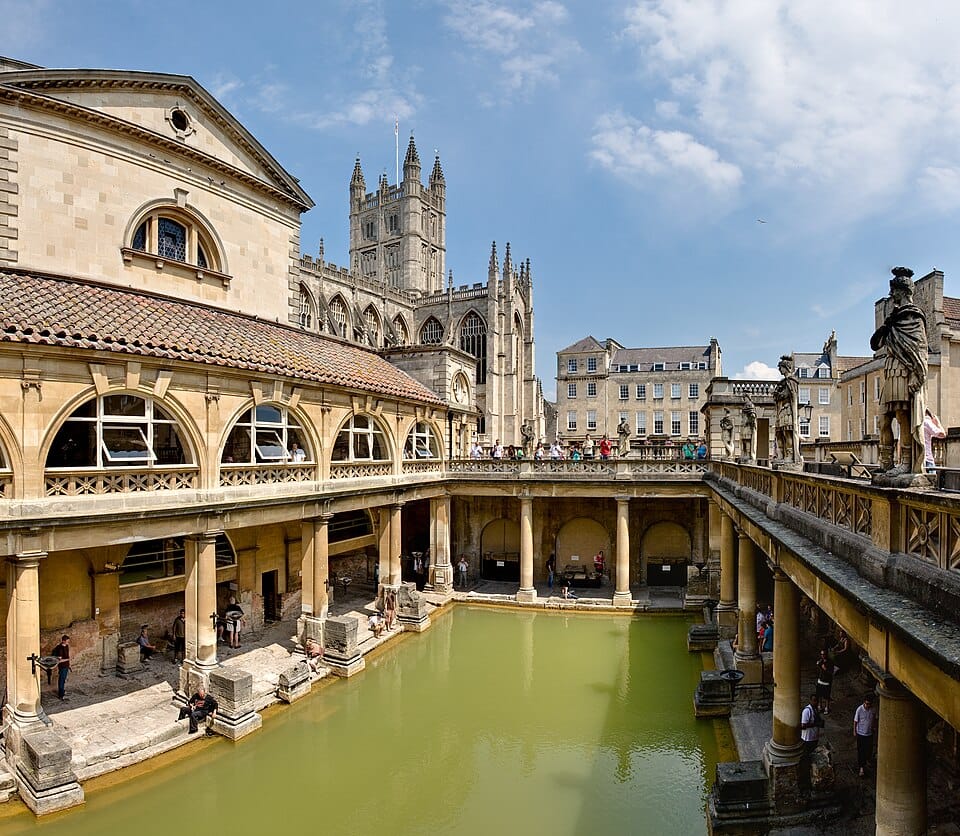
Bath grew up around natural hot springs first developed by the Romans, who built an elaborate bathing complex that still survives beneath the modern city. Later, in the 18th century, Bath was rebuilt in elegant Georgian style with golden limestone terraces and crescents, becoming a fashionable spa resort associated with Jane Austen.
Top attractions in Bath
Roman Baths
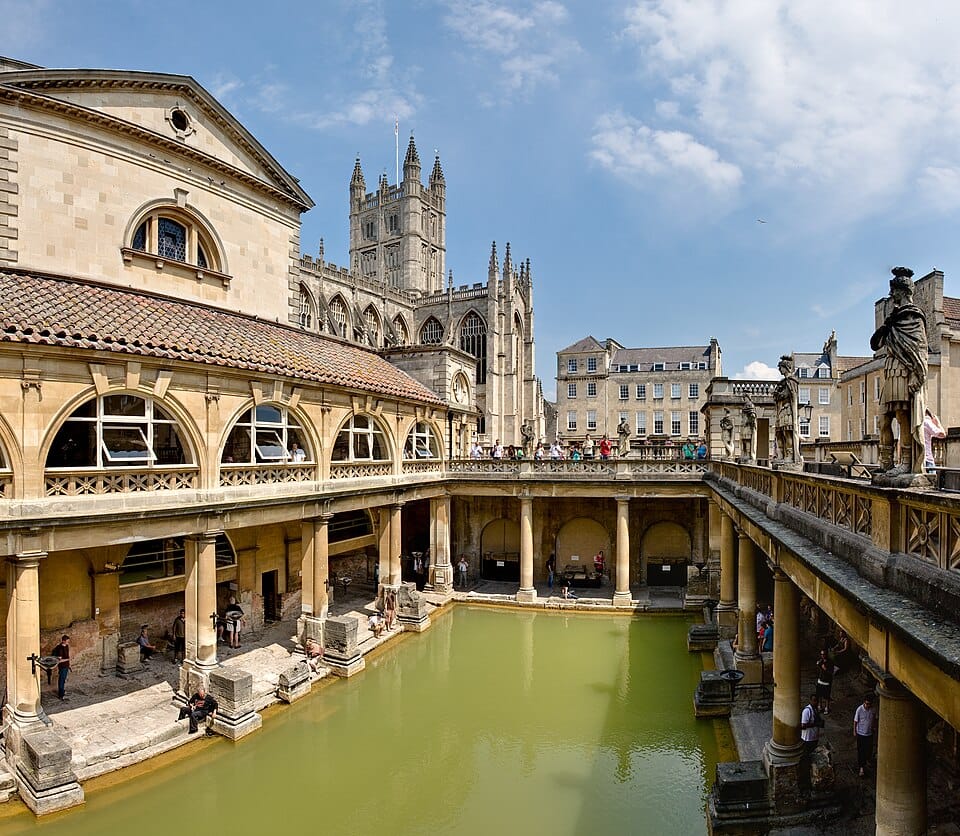
A remarkably preserved Roman bathing complex built around the city's natural hot spring, with the original lead-lined Great Bath still holding steaming water.
Royal Crescent
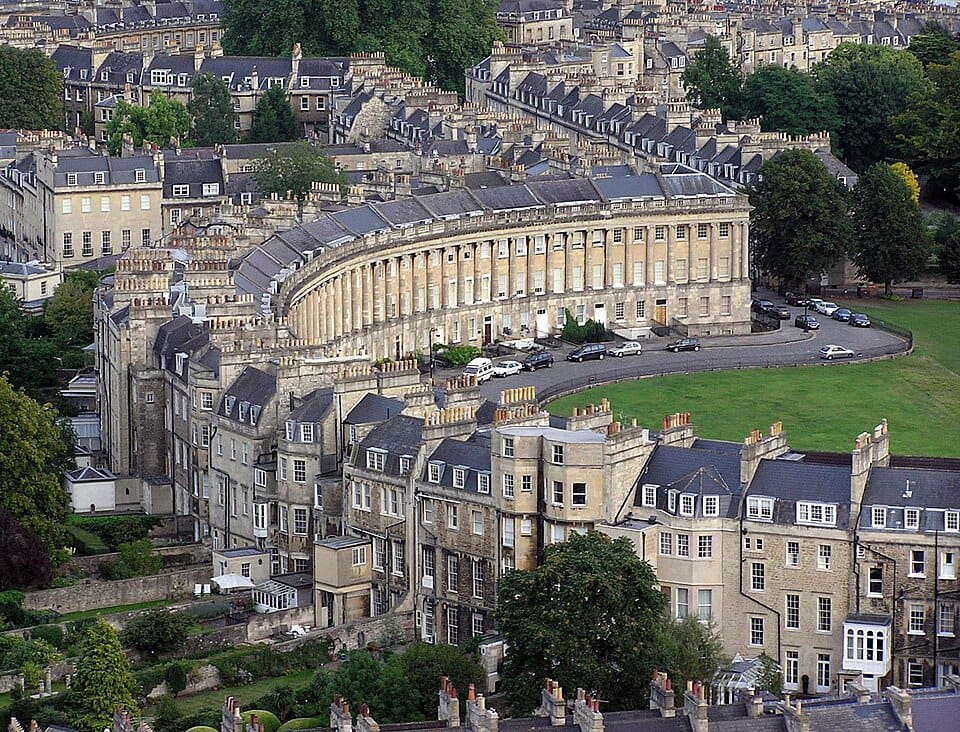
A sweeping row of 30 Georgian terraced houses arranged in a crescent, completed in 1774 and considered a masterpiece of 18th-century architecture.
Bath Abbey
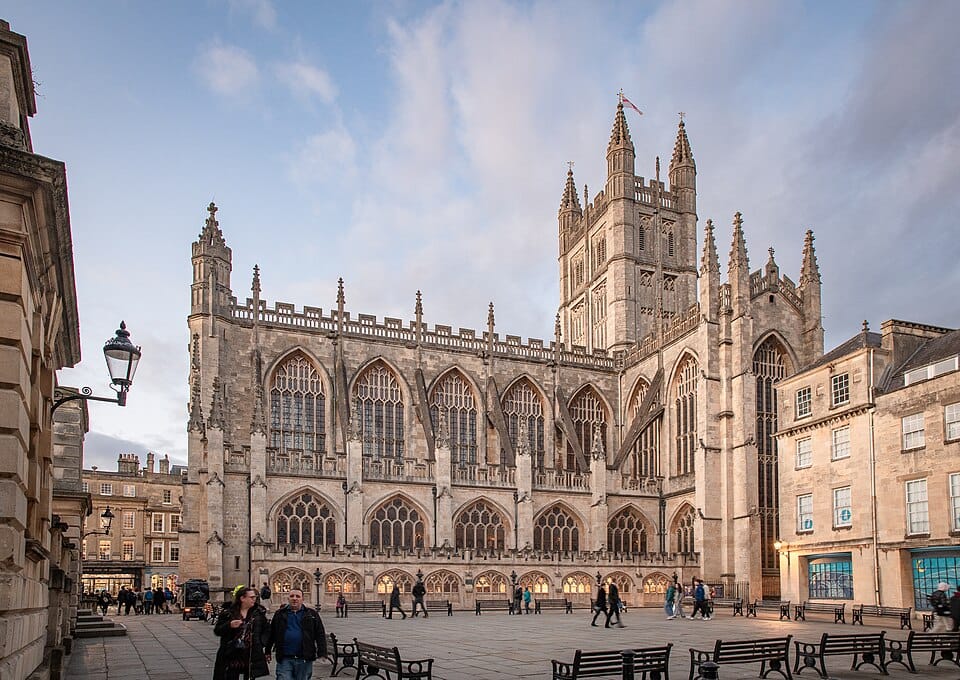
A late-medieval Gothic church known for its fan-vaulted ceiling and as the site where King Edgar was crowned first King of England in 973.
Pulteney Bridge
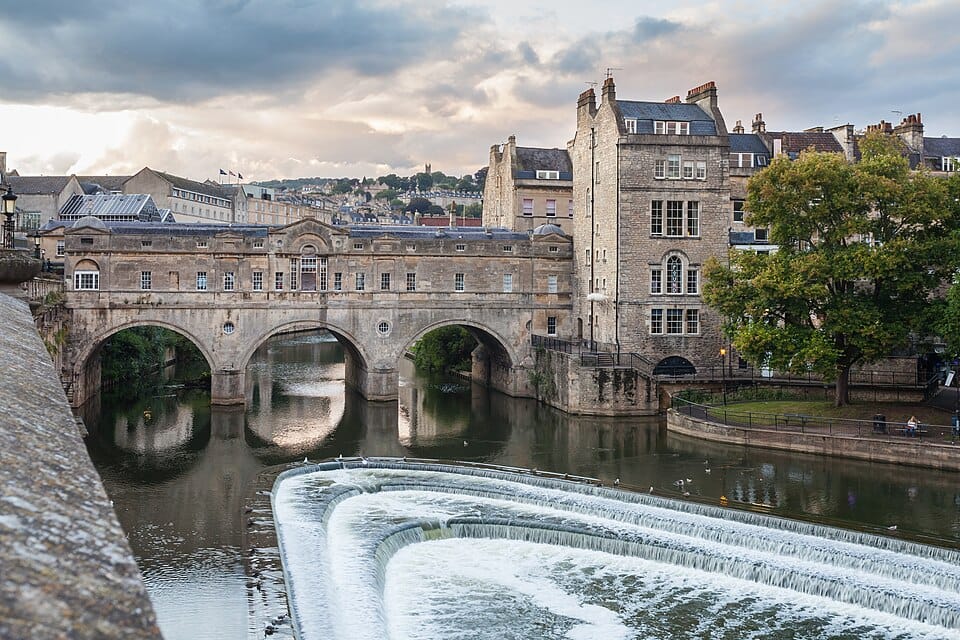
An 18th-century bridge over the River Avon lined with shops on both sides, one of only a handful of such bridges remaining in the world.
Thermae Bath Spa
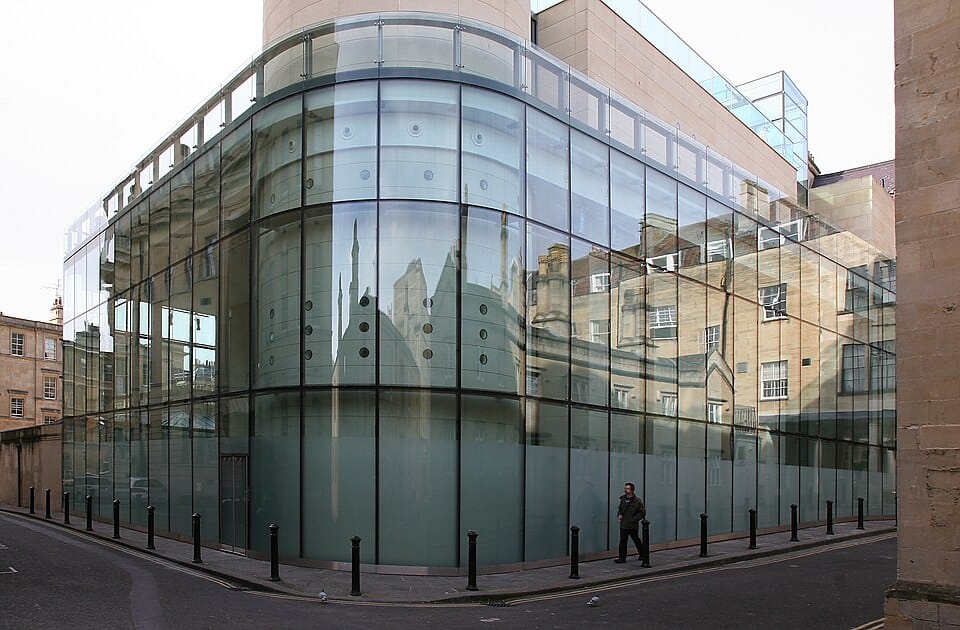
A modern spa complex fed by the same natural hot springs as the Roman Baths, with a rooftop pool offering views across the city's skyline.
York

York is a walled cathedral city in northern England founded by the Romans as Eboracum and later an important Viking settlement known as Jorvik. Its layered history is visible in the Roman walls, Viking-era street names, and the towering Gothic minster that dominates the skyline, making it one of England's best-preserved medieval cities.
Top attractions in York
York Minster

One of the largest Gothic cathedrals in Northern Europe, famous for its medieval stained glass, including the Great East Window.
The Shambles

A narrow medieval street with overhanging timber-framed buildings, once home to butchers' shops and now lined with boutiques and cafes.
JORVIK Viking Centre

A museum built on the site of an archaeological dig that uncovered Viking-era York, recreating the sights and sounds of the 10th-century settlement.
York City Walls

The most complete medieval walls in England, largely built atop earlier Roman defences, with walkable ramparts encircling the historic centre.
Clifford's Tower

The keep of York Castle, built on a mound originally raised by William the Conqueror, offering panoramic views over the city from its ramparts.
Lake District
The Lake District in Cumbria is England's largest national park and, since 2017, a UNESCO World Heritage cultural landscape: a compact cluster of glacial lakes, fells and stone-walled valleys that includes Scafell Pike, England's highest mountain, and Windermere, its largest natural lake. Its scenery shaped English Romanticism through William Wordsworth, who lived in Grasmere, and Beatrix Potter, who bought farms here and left much of her land to the National Trust. Autumn is one of the best times to come, when the bracken on the fells turns copper and the woodland around the lakes glows red and gold.
Top attractions in Lake District
Derwentwater & Keswick
A wooded, island-dotted lake ringed by fells, with lake launches calling at jetties around the shore; the market town of Keswick on its northern end is the natural base for the northern lakes.
Castlerigg Stone Circle
A Neolithic ring of standing stones on a hilltop just outside Keswick, among the earliest stone circles in Britain, with a sweeping panorama of the surrounding fells.
Buttermere & Honister Pass
A quiet lake whose easy shoreline path is especially lovely on calm autumn mornings, when the water mirrors the fells; reaching it from Keswick over the steep, narrow Honister Pass is one of the park's classic drives.
Grasmere & Dove Cottage
The village where William Wordsworth lived and wrote; his whitewashed home Dove Cottage is now a museum, and the poet is buried in St Oswald's churchyard in the village.
Windermere
England's largest natural lake, about 18 km long, with lake cruises linking Ambleside, Bowness and Lakeside; it is the busiest corner of the park, so arrive early to find parking.
Edinburgh

Edinburgh is the capital of Scotland, built across a dramatic volcanic landscape and dominated by the castle perched atop its ancient rock. The city is split between the medieval Old Town, with its narrow closes and tall tenements, and the Georgian New Town, whose ordered squares and crescents form a striking architectural contrast.
Top attractions in Edinburgh
Edinburgh Castle

A fortress perched atop an extinct volcanic rock, home to the Scottish Crown Jewels and the Stone of Destiny, used for royal coronations.
Royal Mile

The main thoroughfare of the Old Town, running from Edinburgh Castle to Holyrood Palace and lined with historic closes, shops, and pubs.
Arthur's Seat

The main peak of an extinct volcano rising above the city in Holyrood Park, popular for hiking and offering sweeping views over Edinburgh.
Palace of Holyroodhouse

The official royal residence in Scotland, built beside the ruins of a 12th-century abbey and once home to Mary, Queen of Scots.
National Museum of Scotland

A wide-ranging museum covering Scottish history, world cultures, science, and natural history, housed partly in a Victorian glass-roofed hall.
Plan this route with EuroDrive Scout — tolls, vignettes, ZTL alerts, fuel & parking →